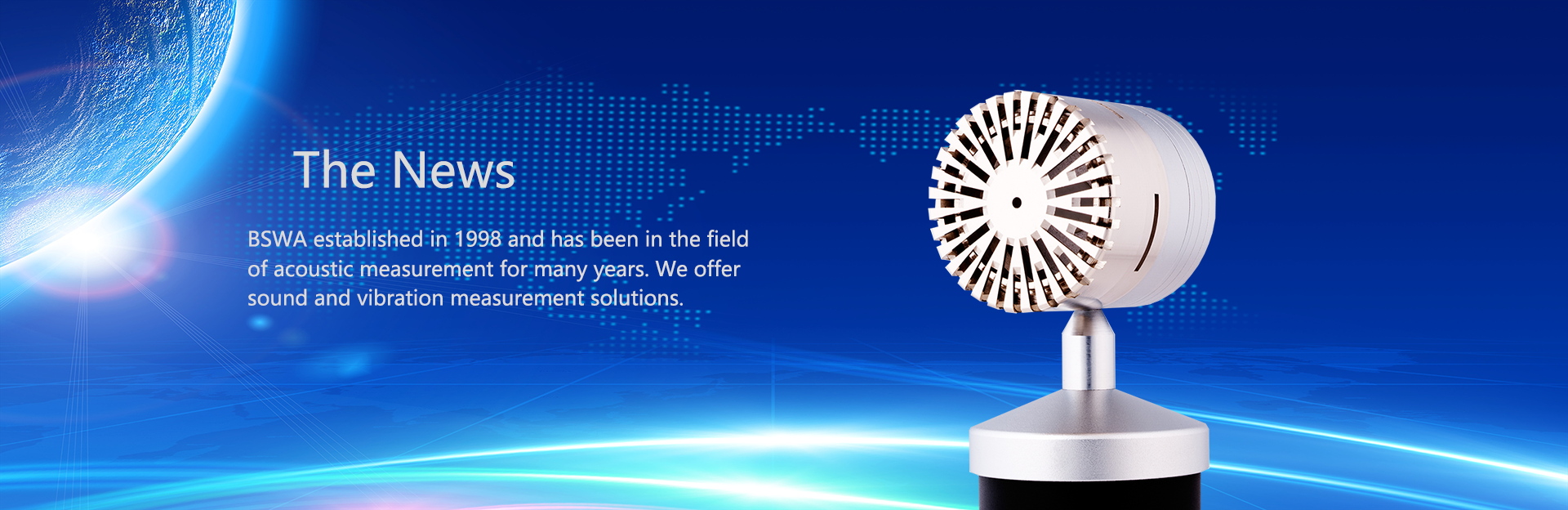
MPA416 1/4" Free‑Field Microphone: The Perfect Partner for Acoustic Array & Source Localization
2026-05-17BSWA MPA416 1/4" Free‑Field Microphone: 20Hz–20kHz, 50mV/Pa, 0V pre‑polarized. Ideal for acoustic array, source localization, impedance tube, NVH & multi‑channel industrial noise measurement.
Overview
The BSWA MPA416 1/4‑inch free‑field microphone is a high‑performance, cost‑effective acoustic measurement sensor optimized for impedance tube testing, acoustic array localization, industrial noise inspection, and source identification. It features 20 Hz–20 kHz frequency response (±3 dB), 50 mV/Pa sensitivity, 29 dBA self‑noise, 0V pre‑polarized design, and a compact lightweight structure. It delivers stable, accurate signals for NAH, beamforming, NVH testing, and production line quality control, making it the best all‑around choice for high‑channel‑count acoustic measurements.
Key Advantages
Ultra‑Wide Frequency Response: 20 Hz – 20 kHz (±3 dB)
MPA416 provides a flat frequency response from 20 Hz to 20 kHz with deviation ≤±3 dB, capturing full‑range acoustic signals from low to high frequencies with consistent accuracy.
High Sensitivity: 50 mV/Pa at 250 Hz
At 250 Hz, the microphone reaches 50 mV/Pa (‑26 dB re 1 V/Pa) sensitivity, ensuring clear capture of weak sound signals even in quiet environments.
Wide Dynamic Range: 29 dBA – 127 dB (3% Distortion)
With self‑noise only 29 dBA and a max SPL 127 dB at 3% distortion, it adapts to both low‑noise lab conditions and high‑noise industrial environments.
0V Pre‑Polarized & Integrated ICP/ICCP Amplifier
The 0V pre‑polarized design eliminates external polarization power; the built‑in non‑detachable ICCP preamp uses 2–20 mA constant current (typical 4 mA), output impedance <110 Ω, max output ±3.16 Vpeak for stable long‑distance transmission.
Compact & Robust: Ø7×61 mm, 8.7 g
Dimensions Ø7×61 mm, weight 8.7 g, SMB connector, operating ‑10°C to 50°C, 0–90% RH, ideal for array mounting and field deployment.
Technical Specifications Summary
| Item | Value |
|---|---|
| Frequency Response | 20 Hz – 20 kHz (±3 dB) |
| Sensitivity | 50 mV/Pa at 250 Hz |
| Self‑noise | 29 dBA |
| Max SPL | 127 dB (3% Distortion) |
| Pre‑polarized | 0V |
| Preamp | ICCP, 2–20 mA constant current |
| Dimensions | Ø7×61 mm |
| Weight | 8.7 g |
| Connector | SMB |
| Operating Temp | ‑10°C to 50°C, 0–90% RH |
Core Applications
Impedance Tube Material Acoustics
Measures sound reflection and absorption for acoustic materials, supporting R&D of sound insulation cotton, panels, and coatings [1].
Acoustic Array & Source Localization
Ideal for NAH (Nearfield Acoustic Holography) and beamforming arrays; used in automotive NVH, machinery fault detection, and building acoustics [2].
Industrial Production Line QC
Fast noise testing for headphones, speakers, home appliances, and rotating equipment; improves quality control efficiency [3].
User Benefits
- Cost‑effective: High performance without redundant functions.
- Plug‑and‑play: 0V pre‑polarized, integrated preamp, simple wiring.
- Traceable calibration: Individual factory calibration data included.
- Array‑ready: Small, light, high consistency for multi‑channel systems.
- Wide compatibility: Works with standard DAQ and amplifiers.
FAQ
What is the frequency range of MPA416?
20 Hz – 20 kHz (±3 dB) for full‑band acoustic measurement.
Does MPA416 need external polarization voltage?
No. It uses 0V pre‑polarized design, no extra power required.
Can MPA416 be used for acoustic array or source localization?
Yes. It is widely used in beamforming and NAH arrays for noise source mapping.
What is the difference between MPA416 and MPA466?
MPA466 adds TEDS (IEEE 1451.4) for automatic sensor recognition; MPA416 is cost‑focused without TEDS.
What is the operating temperature range?
-10°C to 50°C, 0–90% RH, suitable for lab and field use.